Technology & Material
“In the search for processes that solve the conflicting goals of stiffness/strength, long-term stability, weight and cost better than conventional materials, we have abandoned traditional ways of thinking.”
Norbert Stötzner, Head of Research and Development, WEBER FIBERTECH GmbH
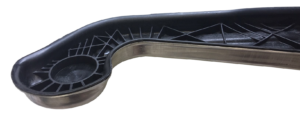
Injection moulding with water injection technology (WIT)
for the production of very long, hollow-shaped thermoplastic components.
Continuous fibre technology (E-LFT)
for local and large-area reinforcement of structural components made of thermoplastic material. The strength and stiffness of these components extends to crash safety.
Hybrid technology (Hybrid-LFT)
enables the automated production of plastic-metal joints, applicable for locally highly stressed areas.
Injection moulding with water injection technology
Injection molding with water injection technology (WIT for short)
WIT is a special injection molding process that enables the process-stable production of very long, hollow-molded thermoplastic components.
Process flow
- Filling the complete cavity in the injection mold with the plastic melt
- Water injection: high water pressure is used to force the melt that has crystallized at the edge and is still liquid in the core out of the cavity
- The liquid plastic mass is pressed into the pacification of the injection molding machine and reused in the next injection cycle (No waste).
- After formation of the complete cavity, the water runs back into the water cycle.
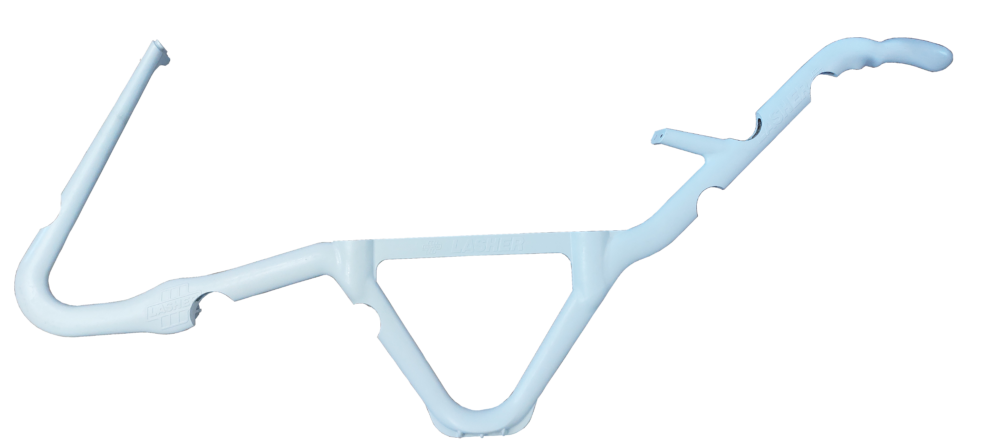
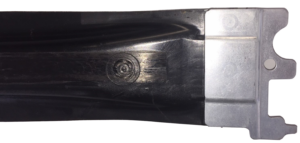
2.2m long plastic component for a wheelbarrow made with WIT technology.
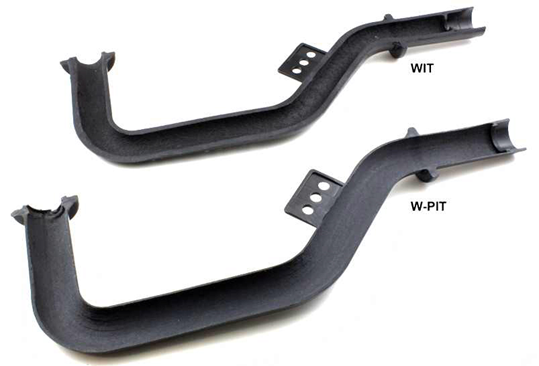
The WIT technology enables a previously unrealisable economic efficiency in production.
Advantages of WIT
Short cycle times, high process stability, no rejects, no reworking of parts in conjunction with a 100% level of automation open up the possibility of competitive production in Europe.
Injection moulding in combination with water injection technology enables the realisation of new complex designs in lightweight construction which cannot be economically produced in metal. The possibility of integrating additional functions such as display, bottle holder or other features offers almost unlimited possibilities both in terms of design but also economically.
E-LFT & Hybrid-LFT
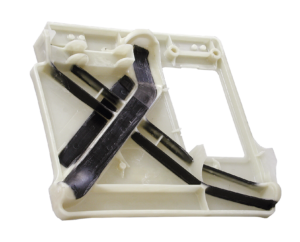
LFT basic structure (white)
- Material PP or PA
- Long glass fiber > 10 mm
- High strength values due to the long fiber content
Profiles from continuous fibers (black)
- High fiber content
- Profiles variable in thickness, width and length
- Local reinforcement results in high-strength components with low weight
- Extensive freedom in the design and construction of the component
- Functional elements can be integrated directly into the process and allow assembly and testing steps to be saved.
- High efficiency due to short cycle times
Continuous fiber technology
(E-LFT for short)
Components produced using the E-LFT process consist of a basic structure made of LFT (white in the picture), which is locally reinforced with continuous fibers (black in the picture).
The E-LFT process has been on the market for over 20 years in large series
The combination of long fiber technology (LFT) and continuous fiber (E-LFT) enables the economical substitution of metal components.
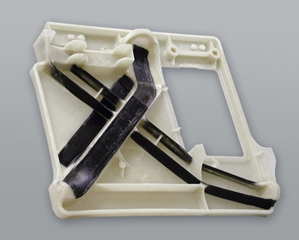
LFT basic structure (white)
- Material PP or PA
- Long glass fiber > 10 mm
- High strength values due to the long fiber content
Profiles from continuous fibers (black)
- High fiber content
- Profiles variable in thickness, width and length
- Local reinforcement results in high-strength components with low weight
- Extensive freedom in the design and construction of the component
- Functional elements can be integrated directly into the process and allow assembly and testing steps to be saved.
- High efficiency due to short cycle times
E-LFT Hybrid process
The E-LFT hybrid process enables thermoplastic components to be joined to steel or aluminum.
Plastic and metal parts and sheets are combined in a single production step using differently developed processes.
The result is lightweight hybrid components that can withstand extremely high local stresses.